Recent protests, like the so-called “freedom convoy,” have denounced government action in response to the COVID-19 pandemic by claiming that government mandates like mask and vaccine mandates infringe on their rights and freedoms.
But using the rights discourse in protests is not new.
Many slogans relating to rights and freedoms used by protestors are decontextualized from the history and theory of rights and freedoms, which unfortunately oversimplifies what rights and freedoms really are. As a PhD student in philosophy, with a strong background in ethics and rights theory, I argue that while rights and freedoms language is politically and socially powerful, most people don’t understand what they are, which ones they are entitled to and the morally binding duties they require of others.
And although formal human rights developments have helped governments and organizations understand what qualifies as basic human rights, the separation of rights from its roots in ethical theory has led to many misconceptions about rights and freedoms and, consequently, its misappropriation by protesters for their movements.
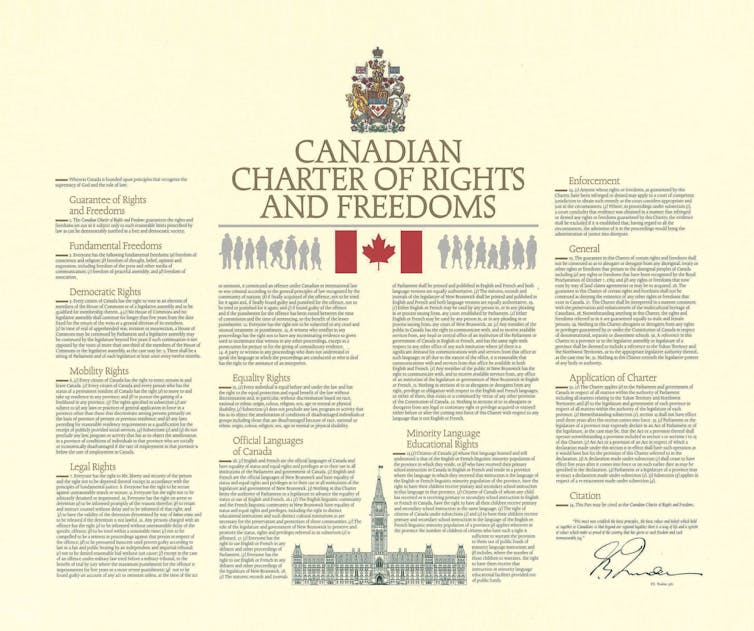
The official English version of the Canadian Charter of Rights and Freedoms. (CANADIAN PRESS/stf)
Limits to freedoms
Recent protesters claim that COVID-19 mandates restrict their freedom because the government is forcing them to act against their will. They assume that, because we live in a free society, anyone can act however they want.
But this claim assumes that someone’s freedom to act trumps everyone else’s.
Simply by being a member of a society, our rights and freedoms are limited. When someone’s actions have the potential to harm other people, as stated in Section 1 of the Charter, those actions are prohibited or punished.
For example, freedom of expression is protected in Canada, but this fundamental freedom is limited as soon as people’s speech and expression becomes hateful and harmful to specific groups or individuals.
When an action — like hate speech or refusing to follow COVID-19 mandates — is deemed harmful to others, the government can limit one person’s freedom to protect the rights and freedoms of others.
The government declared public health orders for COVID-19 because refusing to follow these recommendations puts others at risk of contracting the virus.
Often, protesters leave obligations out of the picture — including the obligations they have to other people.
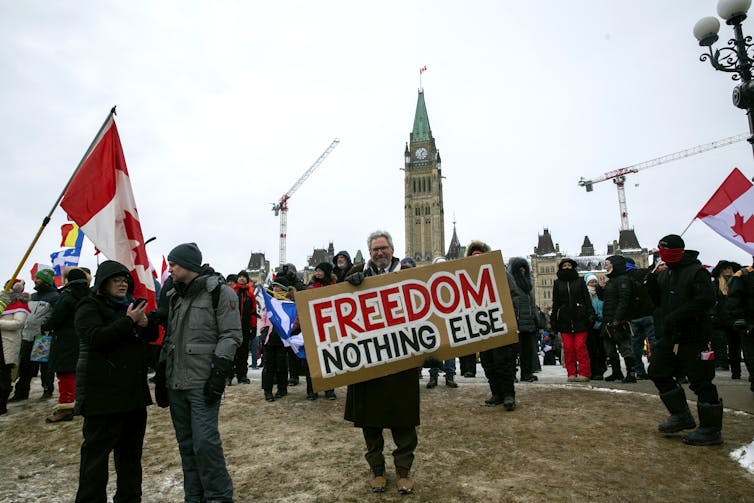
A convoy supporter holds a sign on Parliament Hill to in support of trucks lined up in protest of COVID-19 vaccine mandates and restrictions in Ottawa, Ont., on Feb. 12, 2022. (AP Photo/Ted Shaffrey)
Although the rights and freedoms discourse used in protest is impactful, the failure to discuss these nuances increases polarization on controversial issues. For example, one protest may focus on one or two rights and freedoms and the desire to protect those, while another stakes a claim to different rights and freedoms.
When both claim their rights and freedoms are being violated, it becomes difficult to evaluate which side’s rights are worth protecting. And when this happens we often align with the side that most closely resembles our own beliefs.
Rights are not self-exceptional
Instead of discussing who should be protecting people’s rights and freedoms and how they might conflict with the rights and freedoms of others, protest slogans end up perpetuating attitudes of self-exceptionalism and selfishness.
On the 40th anniversary of the signing of the Charter, it is important to reflect on the rights Canadians share and, more importantly, understand that these rights entail responsibilities to each other.
Perhaps if misunderstandings about rights and freedoms were clarified, there would be a greater sense of unity. And if they matter as much as protesters believe, then we need to evaluate how the support for some rights and freedoms might infringe on the rights and freedoms of others.
I have said this before, the Canadian Charter of Rights and Freedoms isn’t worth the paper its printed on. All the so-called rights and freedoms that Canadians are supposed to celebrate can be taken away at the whim of government. All that is needed is an excuse. They can make something up. Does not matter.
Courts you say? Don’t count on them. Supreme Court Justices are chosen by the Prime Minister.
The key word that the Americans have in their Constitution that is missing in our Charter of Rights is Inalienable.
Inalienable Rights are:
Personal rights held by an individual which are not bestowed by law, custom, or belief, and which cannot be taken or given away, or transferred to another person, are referred to as “inalienable rights.”
The U.S. Constitution recognized that certain universal rights cannot be taken away by legislation, as they are beyond the control of a government, being naturally given to every individual at birth, and that these rights are retained throughout life. To explore this concept, consider the following inalienable rights definition. – Legal Dictionary
In reality, Canadians have zero rights and freedoms. We have privileges granted by governments to a select group of people who do whatever governments say. ‘Good citizens’. You don’t follow governments’ edicts, you lose your privileges. Bad citizens (Right-winged, Nazi Skinhead, White Supremists.)
Instead of rights and freedoms, Canadians have a reward program.